 PinspeedStart a scan
Audit planning · 7 min read
How to Choose Pincodes for an Amazon Delivery Audit
A planning method and free worksheet for choosing which product-location pairs to check repeatedly in an Amazon delivery audit.
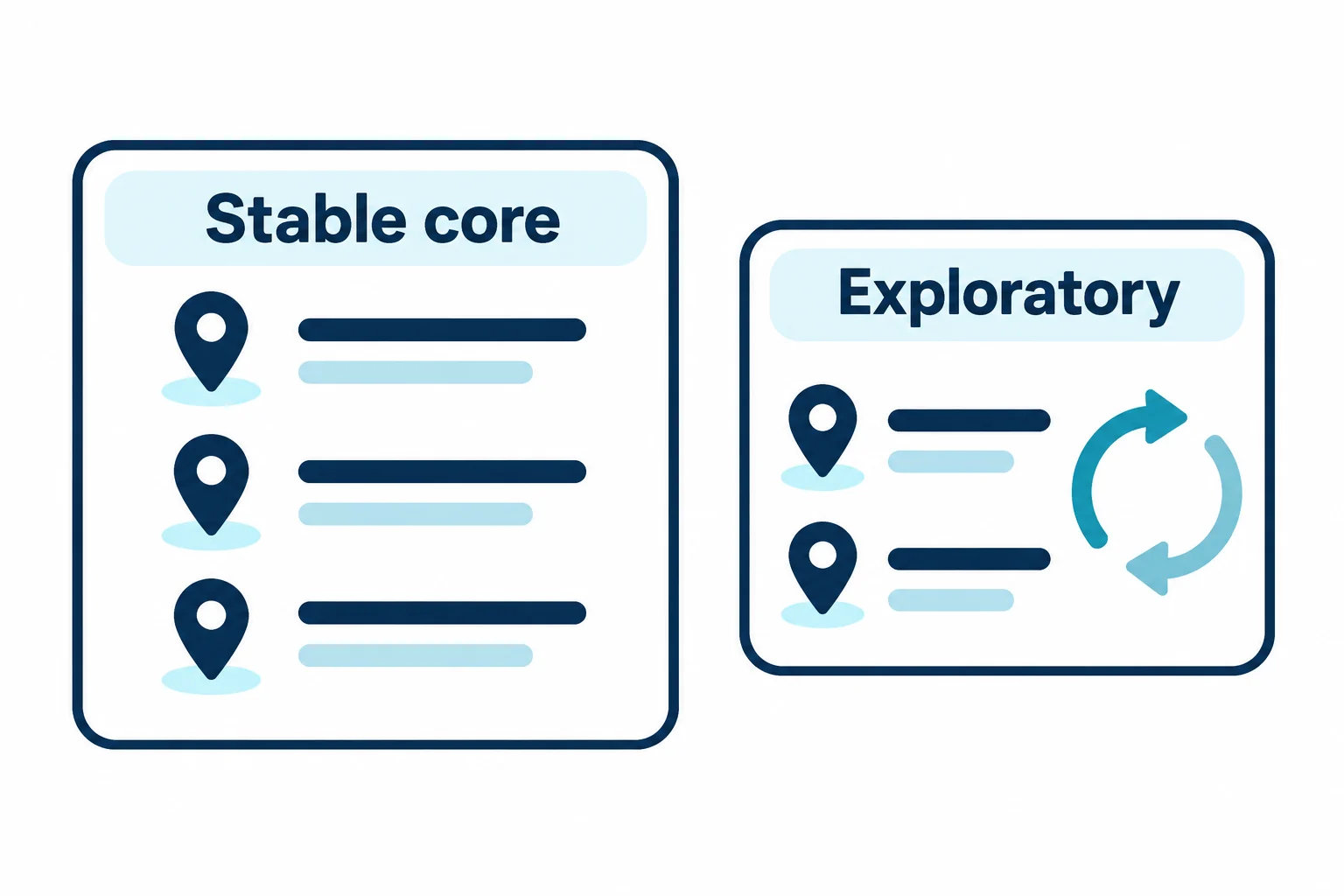
Choose a stable core of pincodes for repeat checks, then keep a smaller exploratory group for new questions. Record why each location belongs, budget for products × pincodes × rounds, and compare the same product-location pairs over time. Your sample describes the locations checked, not all shoppers in a city or across India.
1. Start with the decision you need to make
To decide which pincodes to check in an Amazon delivery audit, start with the question you need to investigate. Are you protecting existing demand, following up a reported concern, or exploring a market?
- Existing demand: locations that matter to the product's current business, using authorised aggregate location data where available.
- Reported concerns: locations connected to a specific enquiry or complaint that needs a listing check.
- Expansion questions: locations tied to a documented business question, such as a planned regional launch.
A location can have several reasons for inclusion. Keep one entry with those reasons, rather than counting the same pincode twice. Avoid choosing a familiar city-centre or default pincode as if it represents all customers in that city.
This audit records the delivery promise displayed before purchase. It does not measure fulfilled delivery performance. For the checking procedure, use our guide to checking Amazon delivery times across pincodes.
2. Build a candidate list from evidence you can access
If your team has authorised aggregate location data, record its product scope, period and source. Use the same period when comparing counts. A period with a promotion or stock interruption may need separate explanation.
Access varies. This method does not assume that every seller has a particular Amazon report or a customer-pincode export. If location-level order evidence is unavailable, use documented enquiries and the markets your business actually serves. Label that list exploratory, not demand-weighted. Record missing counts as unknown, rather than zero.
Past purchases show where orders occurred. They do not show every potential buyer or establish why demand was low elsewhere. Use aggregate counts and short evidence references; the worksheet needs no customer names, street addresses or contact details.
3. Separate a stable core from exploratory locations
The core is the set of locations you intend to check again with the same products. Its purpose is comparability. Choose locations whose repeated observation will answer the main audit question.
The exploratory group tests new questions. It might include an expansion location or a concern needing follow-up. Keep its results separate from the core, and give each question a review date.
There is no universal core size or correct allocation. A demand-focused audit and an expansion-focused audit can reasonably choose different samples. State the trade-off instead of presenting a fixed list of “best pincodes”.
4. Budget for the checks you can repeat
Planned observations = products × pincodes × rounds.
For example, 2 ASINs × 8 pincodes × 3 rounds = 48 planned observations. Retries, offer comparisons and evidence capture add work.
Set a checking budget before adding locations. If the list is too large to repeat, narrow the product scope, reduce the locations, or reconsider the number of rounds. Document what you leave out.
Below is a fictional planning example for Brand A and one product. Counts and labels are invented to explain selection decisions. They are not customer data, delivery results or a recommended coverage list. The team has room for four locations in its next round.
Core: Locations A and B
Location A has 200 recorded orders and Location B has 100 in the same fictional period. The team keeps both in the core to follow its two highest-demand candidates repeatedly.
Exploratory: Locations C and D
Location C has 10 orders and a reported concern to investigate. Location D has no order data available and a documented expansion question. The team includes both as exploratory; D's missing count remains unknown.
Defer: Location E
Location E has 50 orders. It matters to existing demand, but falls outside this four-location budget. The team records that omission. An audit focused solely on demand could choose E instead of an exploratory location.
Retire an answered question
At the planned review, suppose D's expansion question has been answered and no follow-up is needed. The team can retire D from the exploratory list and document the reason. It does not silently replace a core location or treat the revised list as an unchanged sample.
This allocation makes the trade-off visible. It is not statistically representative of Brand A's customers, future buyers or India.
5. Verify the location and keep product context
Use a six-digit postal PIN code and a location label. Use India Post's post-office locator to check the postal-code/location association. A postal lookup does not establish Amazon product availability or a delivery date.
Apply the intended location on the actual product page. Keep the ASIN and variant consistent, and record the time, selected offer or seller when visible, and account context. An observation applies to the location and session checked. A failed check is unmeasured, rather than automatically “unavailable”.
Keep fulfilment context with the product or offer. Amazon's official fulfilment overview distinguishes FBA, where Amazon stores, packs and ships; Easy Ship, where the seller stores and packs and Amazon ships; and Self-Ship, where the seller handles delivery.
Compare like-for-like where possible. If an offer, seller or fulfilment method changes between rounds, label that change and review it separately. A displayed estimate does not establish a warehouse location or explain the cause of a difference.
6. Rotate deliberately and version the sample
- Keep a core location while repeated checks still serve the audit's main question.
- Add an exploratory location when a new, documented question is worth the checking effort.
- Review or retire it when the question is answered, no longer relevant, or needs a different investigation. Record the reason and next action.
- Promote it to the core only when ongoing observation has a clear purpose and fits the budget. Record this as a sample change.
Save a sample version, change date and decision note whenever you add, remove or reclassify a location. Keep the previous list. Compare the product-location pairs present in both periods before describing a change; report new and retired locations separately.
Otherwise, a different overall average may reflect a different location mix. Avoid turning a chosen sample into a national “fast-delivery coverage” percentage. A useful report states what was checked, which pairs stayed comparable and which checks could not be completed.
Use the pincode selection worksheet
The free pincode selection worksheet (CSV) records candidate locations, product and fulfilment context, evidence period, optional aggregate counts, selection reasons, decisions, sample version and review dates. Format the pincode column as text so your spreadsheet keeps each six-digit code exactly as entered. Replace placeholder labels with verified six-digit codes before checking.
This is a planning ledger, separate from the observation-recording worksheet in the first guide. Start with your main question, fill in the candidates, and choose the core and exploratory lists before collecting observations.
Turn the shortlist into a repeatable audit
Run the first round using the manual checking guide. Review unsuccessful checks and save the sample version alongside your observations.
When recurring observation is useful, Pinspeed can help compare displayed promises across your selected ASINs and pincodes. Keep the same distinctions between a displayed promise, an unmeasured check and an actual shipment outcome.