 PinspeedCreate account
Competitor comparisons · 9 min read
How to Compare Amazon Delivery Promises with Competitors
Check the match before you count the gap
For Amazon.in sellers and agencies, a fair competitor comparison starts with the same delivery location, account context and delivery-option basis, plus clearly identified offers. First decide whether the pair counts. Then compare its full delivery dates or ranges. Keep mismatches and failed checks in the log, and recheck before treating a difference as repeated.
Two readable dates can still make an unfair comparison. You might be looking at a different seller, a different pack size, or free delivery on one side and a paid faster option on the other.
Our first guide’s comparison example shows how to leave missing estimates out of a date comparison. This guide takes the next step: checking whether the readable pairs belong in it at all.
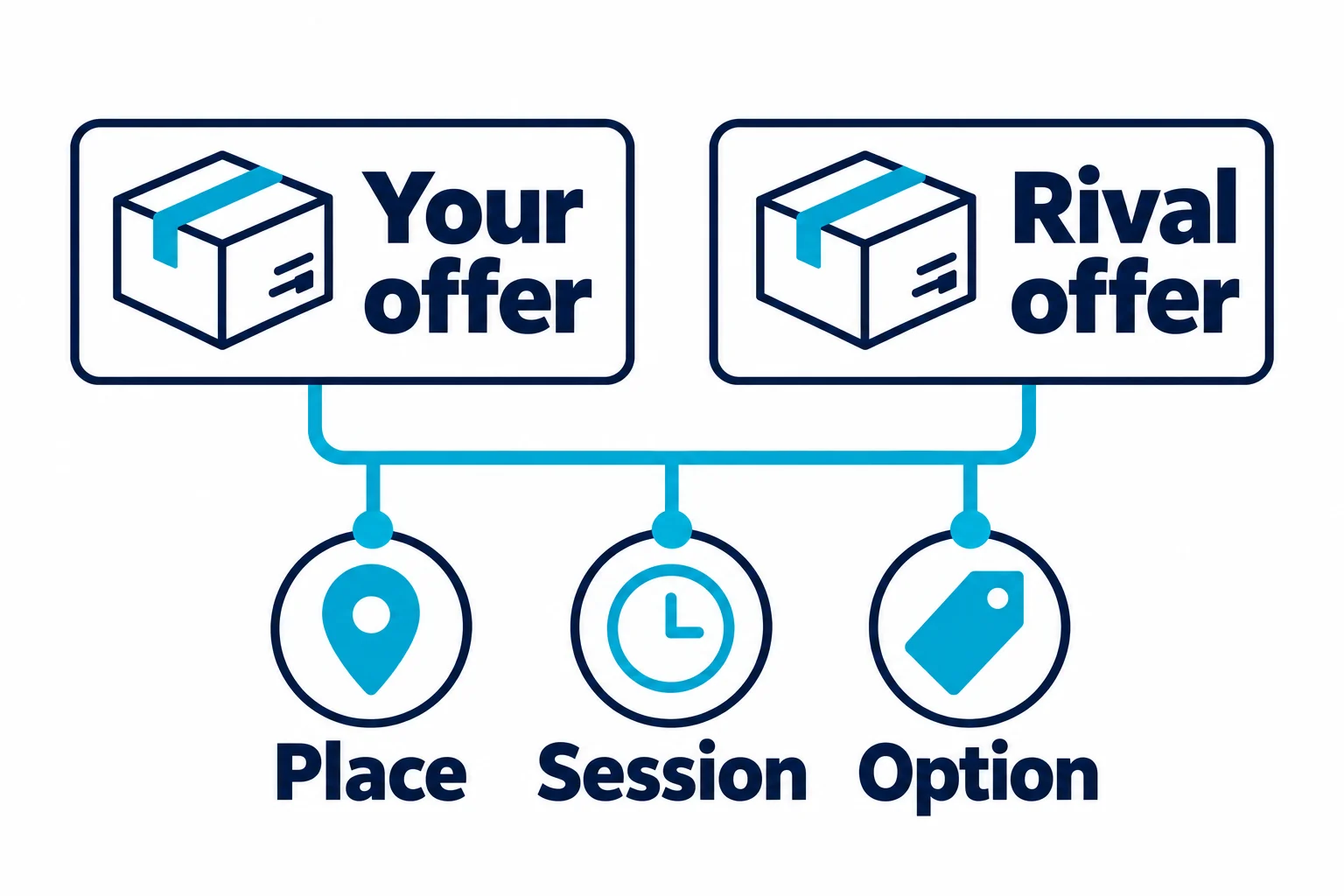
1. Decide which offers you are comparing
Write down the question before opening the pages. Keep these two modes separate.
Same ASIN: compare two declared seller offers
Find your own offer and the declared rival offer by the seller names shown. Keep the exact variant, pack size and condition consistent. The promise beside a default offer from a third seller cannot stand in for your own offer.
If you cannot find a required offer, record “missing offer” and exclude that pair from this round. If the seller identity is unreadable, mark it for a recheck. Avoid assuming a particular button or page layout will always be available.
Different ASINs: compare a declared substitute
A brand owner may want to compare their product with something a shopper could choose instead. Record why that substitute is relevant, along with differences in size, pack, condition or features. This does not establish that the products are equivalent.
Keep the substitute and its selection reason fixed across rounds. Replacing it starts a new comparison series. Report substitute comparisons separately from same-ASIN seller comparisons.
Record the seller and shipper exactly as shown. If fulfilment is known, keep that context too. Amazon India’s fulfilment overview distinguishes who stores, packs and delivers under FBA, Easy Ship and Self-Ship. Do not infer Easy Ship versus Self-Ship from a shopper page. A comparison across methods can describe shopper-facing promises; it does not isolate an operational cause.
2. Decide whether the pair counts
Use a fixed location list from your pincode sample. Confirm the intended location on each page. Use the same browser, signed-in or signed-out state and Prime membership context, without recording account identifiers.
Choose the delivery-option basis in advance, such as the standard free option under the same displayed conditions. Record the service option, fee and any attached condition, including an order-value threshold. “Free versus free” or “paid versus paid” alone does not establish a match. A free-delivery promise and the rival’s paid faster option do not form a counted pair.
Count: both dates are readable and the declared offers, location, session context and option basis meet your chosen mode.
Recheck: a fixable observation problem prevents a fair match: an unconfirmed location, unclear seller, failed page, unreadable date, expired or uncertain cutoff, or the wrong option read when an equivalent option exists. If you opened the wrong variant or pack by mistake, recheck the intended one.
Exclude this round: a required offer is missing or explicitly unavailable, the product does not meet the chosen mode, or no equivalent delivery option is available.
Neither recheck nor exclude contributes to the date comparison now. Keep the attempt and its reason. “Exclude this round” is not a claim that the offer will always be unavailable. A page failure is not evidence of unavailability.
Record both observation times with the timezone, raw promise wording and any “order within” countdown. If a countdown visible during the session expires before both readings are recorded, recheck the pair. Recheck uncertain cutoff states too; a short checking window does not by itself prove the conditions stayed consistent. Alternate which offer you read first between rounds.
Turn “tomorrow” or a weekday into a full calendar date using the observation’s date and time in IST only when unambiguous. Retain the original wording. If you cannot resolve it reliably, leave the date unreadable rather than guessing.
3. Read direction only after the pair passes
A counted pair can still show no clear ordering. Preserve both ends of every range. Treat a single date as having the same earliest and latest date.
- Your promise is later: your earliest date is strictly after the rival’s latest date.
- Your promise is earlier: your latest date is strictly before the rival’s earliest date.
- Tie: both promises show the same single date.
- Overlap: the ranges share any date. Neither promise has a clear ordering under this method, including when a single date falls inside the other range.
Two identical ranges, such as 1–3 November on both sides, are overlapping ranges, not a single-date tie.
If you want one descriptive number, record latest-date gap = your latest promised date minus the rival’s latest promised date, in calendar days. Positive means your endpoint is later; negative means earlier; zero means equal endpoints. This is our recording convention, not an Amazon metric. It does not turn overlapping ranges into a clear advantage or measure actual delivery.
A fictional example: five pairs, four counted
Assume the first four pairs below passed the same-ASIN matching checks. All products, sellers, location labels and observations are fictional. The illustrative check date is 29 October 2026; all promise dates are in 2026. These are not Pinspeed results or recommendations for particular pincodes.
| Case | Promises | Result |
|---|---|---|
| A | Own: 31 Oct Rival: 1 Nov | Counted. Own earlier. Endpoint gap −1 day. |
| B | Own: 31 Oct–2 Nov Rival: 1–3 Nov | Counted. Overlap: no clear order. |
| C | Own: 2–3 Nov Rival: 31 Oct–1 Nov | Counted. Own later. Endpoint gap +2 days. |
| D | Own: 1 Nov Rival: 31 Oct–2 Nov | Counted. Overlap: no clear order. |
| E | Own: 1 Nov Rival: check failed | Not counted. Recheck. No gap calculated. |
Of five attempted pairs, four count: one shows your offer earlier, one later, and two overlap. One needs a recheck. Overlap stays in the counted denominator. This one round cannot establish a repeated difference.
Three other cases follow the same rules: identical single dates are a tie; reading the paid option when an equivalent free option exists needs a recheck; a missing required seller offer is excluded this round. A date being readable does not override an unfair match.
4. Keep one row per paired attempt
Download the blank comparison worksheet (CSV). It contains no customer data, example observations or automatic formulas. Format pincode and identifier columns as text. Use full dates such as 2026-11-01 and timestamps such as 2026-10-29T10:00:00+05:30.
Set a comparison-series ID for the fixed offer pairing and mode, a review-window ID for the period you will assess, and a session ID for each round. Declare the review window before reading its results. Record the exact offers, shared context and option basis, both promises and cutoffs, each observation status, the count/recheck/exclude decision and its reason. Fill direction and endpoint gap only for counted pairs.
- Set up once per series or window: series and window IDs/dates, mode, location, substitute rationale, account context, option basis and both offer identities. Copy these into later rows, but reconfirm them each round. Keep the same wording in the combined offer-detail columns so changes are easy to spot.
- Fill for every attempt: session, pair and retry IDs, displayed prices/fees/conditions, timestamps, raw promises, cutoffs, readable dates, observation statuses, match decision/reason, evidence references and next action. Leave unreadable dates blank.
- Fill for counted pairs only: direction and latest-date gap. Leave both blank for rechecks and exclusions.
A round is one dated checking session. Allow at most one counted pair per location, mode and fixed offer pairing in that round. A same-session retry gets a new pair ID and links back through recheck_of_pair_id; retain the old uncounted row. A later session gets its actual date and a new session ID. A failed Monday check and a successful Tuesday retry give you one counted round, not two.
Use short evidence references. The log needs no customer names, street addresses, login details or account identifiers. Review screenshots before sharing them.
5. Recheck before prioritising an investigation
For a conservative follow-up rule, look for the same strict, non-overlapping direction in at least two counted rounds on separate days within the declared window, with no reversal in that window. Keep location, mode, both offer identities, variant, pack, condition, account context and option basis consistent.
This is an editorial working convention for prioritising investigation, not statistical significance or Amazon policy. Report the direction count out of all counted rounds, including ties and overlaps, with uncounted attempts alongside. A reversal means mixed direction for that window, so it does not qualify under this rule. Preserve that history when opening a future review window.
For example, “own later in 2 of 3 counted rounds on separate days, with no reversal; one overlap; one additional failed attempt” is more useful than “competitor faster”. Keep results by location and mode; if you summarise several locations, give the number meeting the rule out of all locations checked. Your selected sample does not represent all customers in a city or across India.
Take repeated differences to the operational records your team can access. A displayed promise alone cannot identify a warehouse, establish a cause, measure fulfilled delivery performance, or show an effect on rankings or sales.
Sources and scope
Source opened on 29 October 2026:
- Amazon India: shipping and fulfilment options — responsibilities under FBA, Easy Ship and Self-Ship.
The matching checklist, range classifications and follow-up rule are editorial methods. The article measures displayed pre-purchase promises; it does not report completed deliveries.