 PinspeedCreate account
Inventory change measurement · 9 min read
How to Measure Amazon Delivery Promises Before and After an Inventory Change
Plan repeatable Amazon.in delivery-promise checks around an inventory change, compare matched observations, and record uncertainty with a worksheet.
To measure a change in Amazon delivery promises, keep the product, location and offer comparable, collect several observations before and after the stock action, and check the result against that pair’s own baseline variation.
This can show what changed in the promises displayed to a shopper in your sample. It cannot prove your inventory action caused the change, reveal which warehouse served a location, or tell you whether orders arrived faster. Actual delivery performance needs separate order evidence.
This guide is for Amazon India sellers and agencies planning replenishment or a change in stock allocation. The method works with manual observations; it does not require a particular tool.
1. Record the action before choosing the comparison window
Write down the affected ASINs and variants, what you intend to change, and which operational records can confirm it. A shipment leaving your premises, a receipt being recorded and stock appearing available for sale are different milestones. Keep their timestamps and uncertainties instead of calling them one “effective date.”
Your records will depend on the fulfilment arrangement. Amazon’s India fulfilment overview distinguishes FBA, where Amazon stores, packs and delivers; Easy Ship, where the seller stores and packs and Amazon delivers; and Self Ship, where the seller arranges all three. This guide does not prescribe stock-transfer procedures or assume that you control Amazon’s final FBA placement.
Before looking at follow-up results, choose a settling interval and a schedule based on the milestones you can verify. Record the reason. There is no universal waiting period in this protocol. If a receipt is delayed, annotate the schedule change rather than quietly shifting the window until the numbers look better.
No baseline? If the change has already happened and you have no comparable earlier observations, start monitoring now. Do not reconstruct a “before” result from memory.
2. Plan repeated rounds and a small reference set
Choose a fixed list of ASIN/variant–pincode pairs. The pincode-selection guide helps you choose a useful sample; the manual audit guide explains how to capture a promise.
Use several baseline and follow-up rounds at comparable local times and weekdays. For illustration, our worksheet uses three rounds before and three after, one week apart. That is a teaching example, not a statistically sufficient sample size or a recommendation for how long stock takes to settle.
Add a small reference set of ASINs with no planned inventory change, checked in the same pincodes and rounds. Record any changes that affect them too. References can reveal a shared pattern; they are not a controlled experiment and do not establish causation.
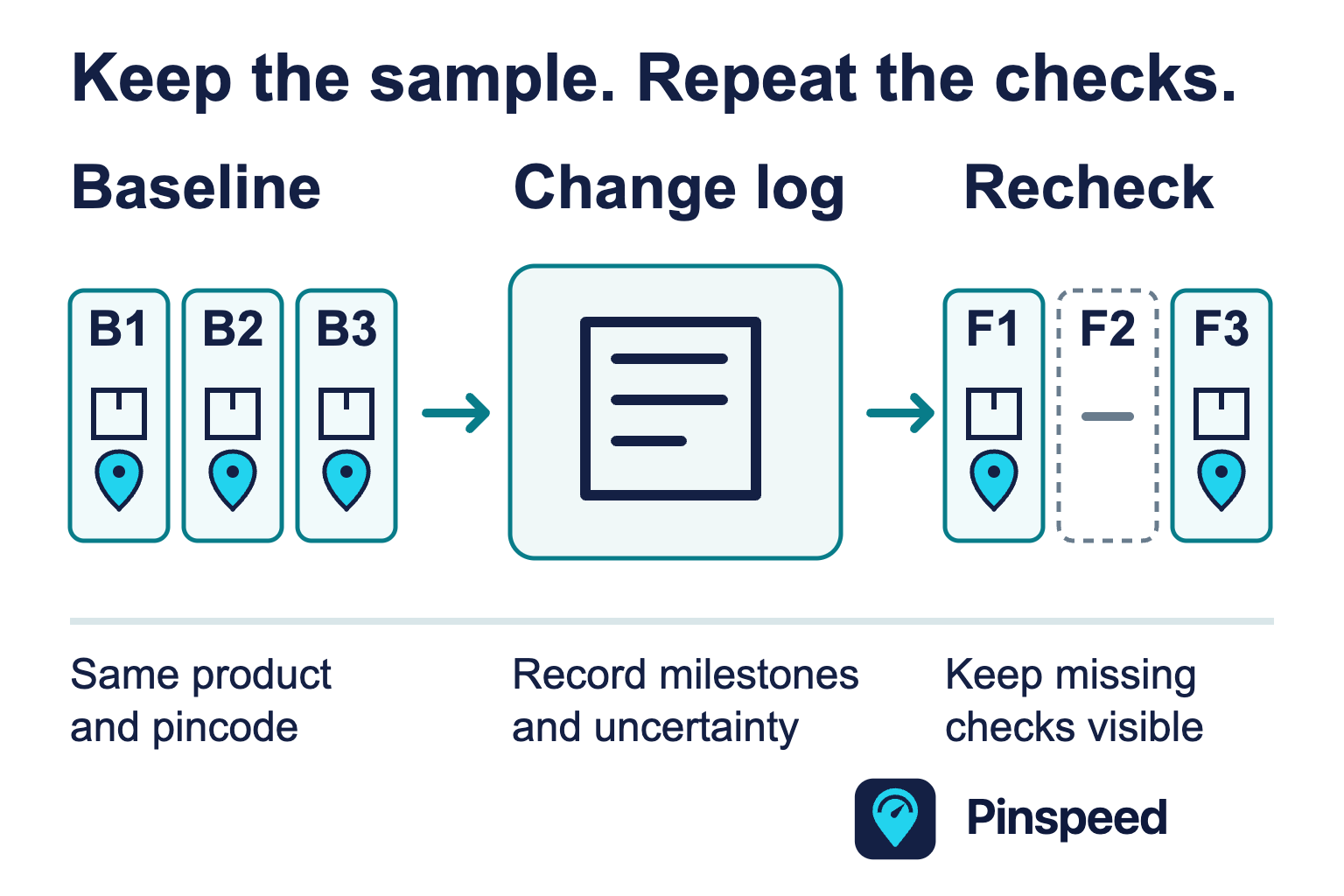
- Baseline rounds B1–B3Capture each target and reference pair. Keep the variation.
- Action log and settling intervalRecord milestones, uncertainty and your planned follow-up window.
- Follow-up rounds F1–F3Repeat the same conditions. A missing F2 stays missing—not zero days.
- Compare relative daysSubtract each observation’s local date from its promised date endpoints.
3. Keep matching conditions and availability visible
For each observation, record the ASIN and variant, pincode, displayed seller/offer, fulfilment context, delivery option, timestamp and timezone. Keep observable login or membership conditions, device class, delivery cutoff wording and collection method consistent where possible. If a condition is unknown, record it as unknown.
A different seller’s offer is not evidence about your own stock action. If the seller, offer or fulfilment context changes, retain that observation but flag the pair as noncomparable for the matched promise calculation.
Record availability separately from date readability. “Unavailable,” an available offer without an interpretable date, and a failed capture are different observations. Preserve transitions in both directions: unavailable to available, and available to unavailable. Neither should disappear from the report just because you cannot calculate a matched date difference.
4. Convert dates into comparable calendar-day offsets
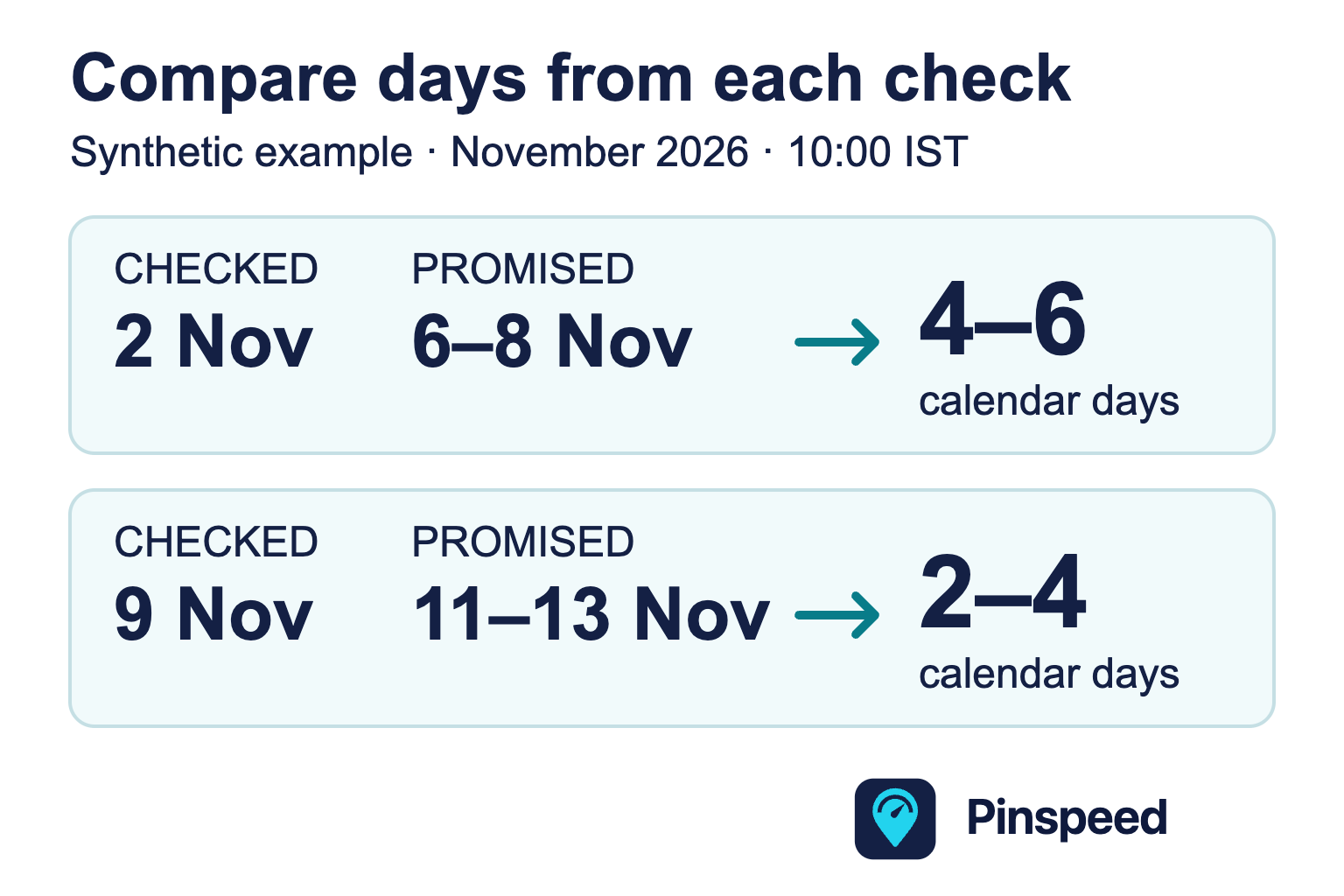
Save the displayed text and both endpoints of a date range. Then subtract the observation’s local calendar date from each promised date, using Asia/Kolkata for this India example. Today is 0 and tomorrow is 1. For a single promised date, use the same value for both endpoints.
Synthetic arithmetic: at 10:00 IST on 2 November 2026, a 6–8 November promise becomes 4–6 calendar days. At 10:00 IST on 9 November, an 11–13 November promise becomes 2–4 calendar days. Comparing the raw November dates would obscure the shorter relative range.
These offsets are not elapsed hours, business days or measured transit time. Keep the raw dates, timestamp, option and session conditions so another person can check the calculation.
5. Compare against each pair’s own baseline spread
Look at the smallest and largest earliest offset in that pair’s baseline rounds, then do the same for the latest offset. Do not combine different products or locations into one baseline spread. A pair with baseline ranges 2–4, 3–5 and 2–5 has an earliest-endpoint spread of 2–3 and a latest-endpoint spread of 4–5.
Declare your classification rule before seeing the follow-up. Here is the conservative descriptive rule used in the example. It deliberately leaves some results inconclusive; it is not a statistical significance test.
- Observed unchanged: both endpoints are identical in every baseline and follow-up round.
- Consistently shorter: every follow-up has both endpoints at or below their respective baseline minima, and at least one endpoint strictly below its minimum in every follow-up. Consistently longer uses the baseline maxima and the reverse comparisons.
- Within baseline variation / inconclusive: every follow-up endpoint stays within its corresponding baseline spread. Small movements here are not counted as improvements.
- Mixed: outside those earlier rules, endpoints move in opposing directions beyond their baseline spreads, or rounds show opposing beyond-spread directions.
- Other inconclusive: remaining overlapping or inconsistent patterns that do not meet a rule above.
Apply the rules in that order. Only pairs with readable dates and matched conditions in all declared rounds enter these promise classes. Incomplete pairs remain outside that denominator as insufficient coverage; keep their partial observations for context.
A synthetic example with improvements, setbacks and gaps
Every value below is fictional. Product labels A–J and references R1–R2 are placeholders, not customer data or real ASINs. All observations use one illustrative pincode, 600001, at 10:00 IST. Baseline dates are 2, 3 and 4 November 2026; follow-ups are 9, 10 and 11 November. A fictional receipt is logged on 5 November, availability on 6 November, and a predeclared 7–8 November settling interval. This schedule is not advice on Amazon processing times.
A · shorter
Baseline B1/B2/B3: 4–6; 4–6; 4–6
Follow-up F1/F2/F3: 2–4; 2–4; 2–4
Both endpoints are below the baseline minima in every follow-up.
B · longer
Baseline B1/B2/B3: 2–3; 2–3; 2–3
Follow-up F1/F2/F3: 4–5; 4–5; 4–5
Both endpoints exceed the baseline maxima in every follow-up.
C · unchanged
Baseline B1/B2/B3: 3–4; 3–4; 3–4
Follow-up F1/F2/F3: 3–4; 3–4; 3–4
All six ranges are identical.
D · inconclusive
Baseline B1/B2/B3: 2–4; 3–5; 2–5
Follow-up F1/F2/F3: 3–4; 2–5; 3–5
Every follow-up endpoint remains within its baseline spread.
E · mixed
Baseline B1/B2/B3: 3–5; 3–5; 3–5
Follow-up F1/F2/F3: 2–6; 2–6; 2–6
The earliest endpoint shortens but the latest lengthens beyond baseline.
F · noncomparable
Baseline B1/B2/B3: 3–4; 3–4; 3–4
Follow-up F1/F2/F3: missing; missing; missing
Available to unavailable; no readable follow-up promise.
G · noncomparable
Baseline B1/B2/B3: missing; missing; missing
Follow-up F1/F2/F3: 3–4; 3–4; 3–4
Unavailable to available; no readable baseline promise.
H · noncomparable
Baseline B1/B2/B3: 3–4; 3–4; 3–4
Follow-up F1/F2/F3: 2–3; 2–3; 2–3
Seller/offer changes in follow-up. Retain the observation, not a matched speed conclusion.
I · insufficient coverage
Baseline B1/B2/B3: 3–4; 3–4; 3–4
Follow-up F1/F2/F3: 3–4; missing; 3–4
Follow-up F2 capture fails; partial dates do not complete the comparison.
J · noncomparable
Baseline B1/B2/B3: 3–4; 3–4; 3–4
Follow-up F1/F2/F3: 2–3; 2–3; 2–3
Displayed fulfilment context changes in follow-up.
R1 · unchanged · reference
Baseline B1/B2/B3: 3–5; 3–5; 3–5
Follow-up F1/F2/F3: 3–5; 3–5; 3–5
Reference pair; no planned inventory action.
R2 · unchanged · reference
Baseline B1/B2/B3: 2–4; 2–4; 2–4
Follow-up F1/F2/F3: 2–4; 2–4; 2–4
Reference pair; no planned inventory action.
Of 10 planned target pairs, 8 have at least one readable date in each period. Only 5 have complete readable dates and matched conditions across all six rounds. Those 5 comprise 1 shorter, 1 longer, 1 unchanged, 1 mixed and 1 inconclusive. The other 5 remain outside the promise-class denominator. Repeated rounds do not turn these into 60 independent pairs.
Keep separate flags for 2 availability transitions, 1 changed offer, 1 changed fulfilment context and 1 capture failure. Flags can overlap in real data, so do not add them to promise-class totals. The 2 reference pairs are reported separately: both remain unchanged in this fictional set. That supplies context, not proof that the inventory action caused A’s shorter promise.
6. Turn the pattern into a bounded next action
Shorter targets; stable references
Say: “These sampled target promises were shorter beyond their observed baseline spread while our references were stable.”
Next: check milestone alignment and concurrent changes, then repeat the observations. Do not claim the stock action caused the difference.
No clear change
Say: “We did not observe clear shortening beyond baseline variation.”
Next: check timing and coverage, then continue the declared plan. This does not prove that the action had no effect.
Longer, mixed or shared movement
Say: which pairs lengthened or remained mixed, and whether references moved too.
Next: inspect conditions and time patterns. Use the slow-delivery investigation guide; do not reverse a stock decision on this observation alone.
Availability, offer changes or missing data
Say: what changed and why a matched promise conclusion is unavailable.
Next: verify the relevant operational record or matching condition and capture later readable promises. A failed capture is not an unavailable product.
In your client or internal summary, keep the sample, rounds, denominators and uncertainties next to the finding. The agency report guide provides a reporting structure. A small selected sample cannot describe every shopper in India.
Keep a record someone else can check
Download the blank observation worksheet, change-plan sheet and synthetic worked example. Read the field and classification instructions first. These UTF-8 CSV files contain no formulas; preserve the raw dates and calculate offsets in your own spreadsheet if useful.
The observation file groups fields into identity/context, availability and capture status, raw dates and offsets, and matching/classification. The plan sheet records milestones, round schedule, settling rationale and rule version. Keep private operational records in your authorised systems; reference them by a non-sensitive note rather than copying customer information into this worksheet.
If Pinspeed’s current options suit your repeated checks, you can create a Pinspeed account. Account creation is separate from scan access. Keep your own dated records and confirm access and history limits before relying on a tool for the full comparison.